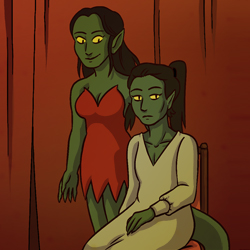
Kor'onen Sisters
| Subspecies: | Lizardfolk |
|---|---|
| Gender: | Female |
| Born: |
880 (Kyveli)
881 (Korrine) |
| Died: |
959 (Kyveli)
1013 (Korrine) |
| Family: | Kalyna (Daughter) |
This article is about the two political figures from the 900s. For their grandchildren from the 1000s, see Kesti Kor'onen and Kiana Kor'onen.
Kyveli Kor'onen and Korrine Kor'onen, frequently referred to collectively as the Kor'onen Sisters, were two members of the prestigious Kor'onen family in Iryna and influential political figures in the early 900s. They are primarily known as the instigating force that resulted in the construction of Iryna's upper platform and the urban development of the city's second level.
Early Life
Kyveli and Korrine Kor'onen were raised in the Old Iryna district. At the time, Old Iryna was the home of the city's elite, the wealthiest and most influential Irynians who controlled most positions of political power. The Kor'onens were of a particularly prestigious lineage; their ancestor[Note] had been the city's first Champion when the position was first established in 522. As they grew, the sisters displayed significant differences in temperaments and talents; Korrine was more proficient in spellcasting, but lacked Kyveli's natural charisma. Korrine's magical talents and serious disposition made her an obvious choice for the position of Champion, which she was appointed to as soon as she came of age. Kyveli, meanwhile, was more suited to the life of a socialite, spending her days hosting lavish gatherings at the Kor'onen residence in Old Iryna.
Political Careers
Despite the fact that only one of the Kor'onen sisters held official public office, both of them were very closely involved in policy-making decisions. The primary political issue of the early 900s, at the beginning of the sisters' careers, was a shortage of available land for housing. As Iryna's growth had accelerated, construction in the city had also accelerated to meet demands, with oversight neglected in favor of maximum output. Structural quality, reliable access to basic utilities, and rational urban design suffered as a result. The obvious solution, in the eyes of elite Irynians like the Kor'onens, was to demolish all substandard housing and start over from scratch. New constructions would be owned by the city, and residents would pay a fee to inhabit units within the buildings, which would help cover the cost of such a significant project. The opinions of Irynians living in these residences, who would be temporarily displaced by demolitions and ultimately be the ones paying said fees, were not taken into consideration. However, some government officials believed that this ambitious plan still did not go far enough. Ultimately, no matter how many new buildings were created, population growth would still outpace the amount of buildings that were possible to construct on Iryna's exceptionally small landmass.
The Kor'onen sisters believed that Iryna was on the verge of disaster, and by providing the solution to Iryna's potentially-fatal flaw, they could ensure their family's supremacy for generations to come. Well-educated and intelligent, the Kor'onens scoured every academic publication they could find, hoping to find a viable but unexplored idea that they could exploit. Finally, they found their answer: a proposal for a platform to be constructed above the city which would effectively double its area, inspired by the raised lookout towers of Evridiki. The technology and spellcraft that would allow for this infrastructural marvel to exist was still in development, but the Kor'onens decided to stake their legacy on its success. The two sisters poured their considerable wealth into research, providing engineers with nearly-unlimited funding on the condition that credit for their achievements would be attributed to the Kor'onens. They also took full advantage of their connections to promote the project; Korrine sought support through official channels in Parliament and the Governor's Mansion, while Kyveli struck deals with fellow elites over lavish banquets.
The Kor'onen sisters were too powerful for most to dare oppose, and no alternative solutions were proposed that sufficiently addressed the city's concerns. Demolitions were carried out with impunity, and construction began in earnest in the year 916. It took several decades to complete the platform, its support pillars, and the hundreds of buildings required to populate them. The Kor'onens largely left the urban design of the upper platform to their team of anonymous engineers, but intervened in the creation of a new district called Upper Old Iryna. The sisters secured private funding from their Old Irynian neighbors by promising them prime real estate in Upper Old Iryna, specially tailored to their needs and preferences. The platform as a whole was presented to wealthy Irynians as an exclusive refuge from what had become an uncomfortably crowded and poverty-stricken city. The elites relocated en masse; as a consequence, their former residences in Old Iryna became available for less-fortunate Irynians to inhabit, although this was most likely an unintentional side effect rather than a deliberate means of averting homelessness.
Retirement
Iryna's upper platform was an incredible achievement and had the desired effect of alleviating housing shortages in the city. However, once the platform itself was completed, the frantic pace of construction screeched to a halt. At one point, almost 30% of Irynians were employed by the platform construction committee; once the platform was built, most of these workers lost their jobs, and the economy took a sharp downturn as a result. Iryna faced an entirely new social issue: many newly-constructed homes stood empty, since no one could afford to live in them. Those who could not find sufficient work instead sought out extralegal means of survival, and crime rates soared. The obvious scapegoats for this city-wide crisis were the Kor'onen sisters, and public opinion on their accomplishments soured. A new generation of leaders in the mid to late 930s advocated for a more sober approach to administration, prioritizing stability over radical change.
The Kor'onen sisters were not insensitive to these changing ideals, and were comfortable in the knowledge that they had ensured their names' entry into Irynian history, regardless of future events. As such, they began to withdraw from public life, with Korrine resigning from the position of Champion in 939. The Kor'onen sisters retired to their estate, the grandest of all mansions built in Upper Old Iryna. It had been frequently remarked-upon that unlike most elite families, neither Kor'onen sister had any heirs to carry on their family name. This blunder was rectified when Kalyna Kor'onen was born. Kyveli and Korrine refused to comment on which sister was the child's biological parent, to ensure that Kalyna could benefit from the combined reputation of both Kor'onens.
Kyveli Kor'onen was the first sister to pass away at the age of 79, a very respectable age for any Irynian to reach. Korrine Kor'onen, however, surpassed her considerably, passing away at the age of 132. Korrine lived long enough to see her granddaughter Kesti Kor'onen appointed to the position of Champion, which served as concrete proof that her legacy had been successfully secured.
Legacy
It would not be an exaggeration to say that the Kor'onen sisters are the two most historically significant figures in all of Iryna. The platform they envisioned became the home of hundreds of thousands of Irynians, allowed the city to expand more than ever thought possible, and even served as the infrastructural base of the IrynaNet decades later. Their descendants continue to be important members of Irynian society up until the contemporary era. However, the callous nature of the Kor'onen sisters' restructuring of Iryna has been increasingly critiqued by later analysts. The social order that allowed the Kor'onens to prosper was ultimately irrevocably altered by their actions, with the Upper Old Irynians losing their stranglehold on power by the late 1010s.
Note: A unique aspect of lizardfolk biology is that some individuals are capable of parthenogenesis, or asexual reproduction. Every member of the Kor'onen family is a genetic copy, or clone, of their ancestral matriarch. The Kor'onen "sisters", although born at different times and exhibiting different visual traits, were in some ways more like identical twins.